
Cooling Tower Zandvliet
- Owner
- ENGIE Electrabel
- Asset
- Natural-draught cooling tower, 87.5 m high, 57 m base diameter
- Location
- Zandvliet, Port of Antwerp, Belgium
- Built
- 2003 to 2004
- Engineering
- SANACON
- Study
- 2021 to 2022
Background & Challenge
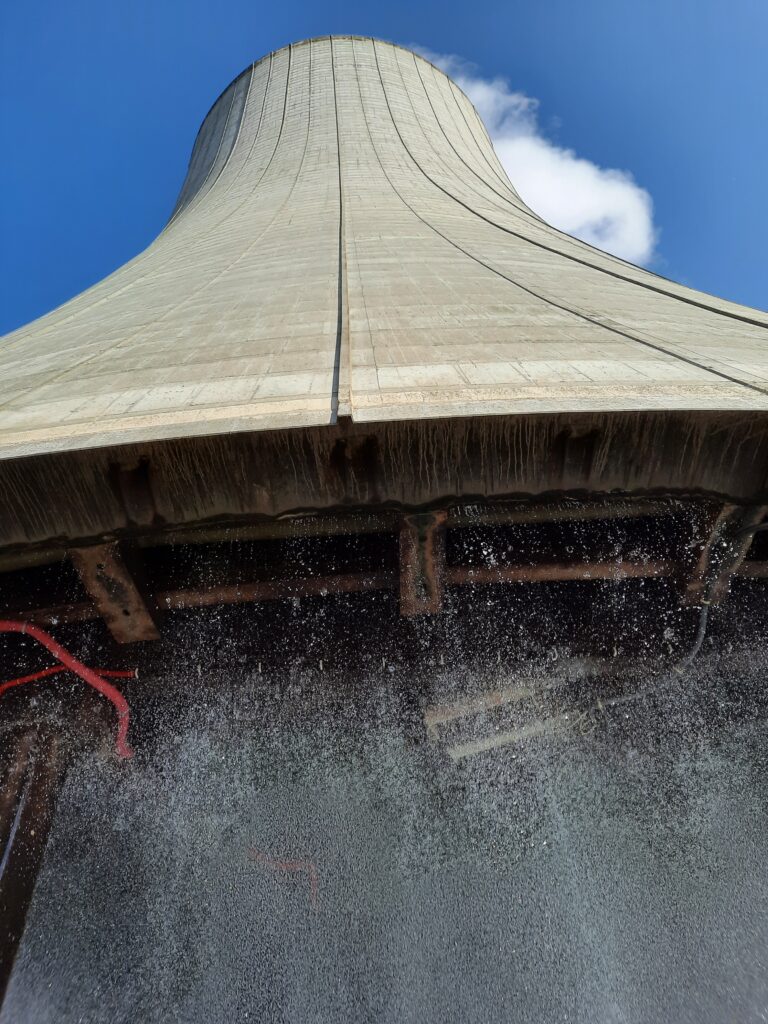
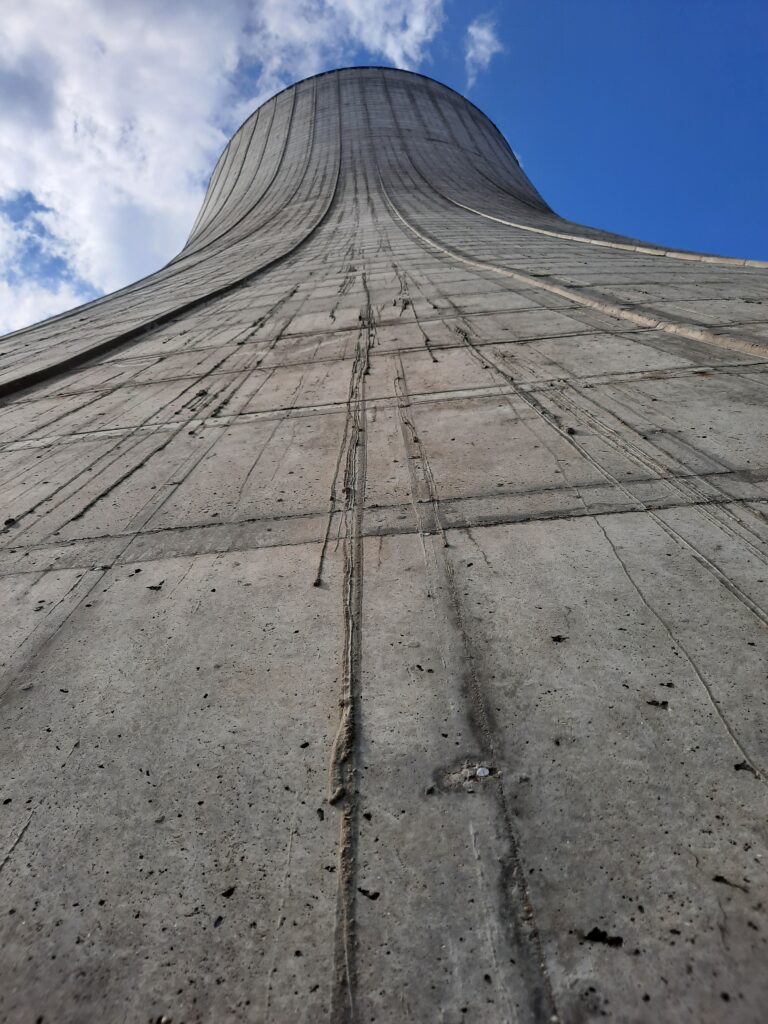
The hyperbolic cooling tower at the Zandvliet power plant operates with treated brackish water in an industrial port environment. Rust stains, cracks and loose concrete on the outer shell raised questions about the actual condition of the structure.
The owner wanted to know the current state of the concrete shell, how damage would evolve, and where to act first, in order to plan maintenance actions and budgets on a well-founded basis.
The Solution by Sanacon
Drone inspection and plan of approach: A visual inspection with drone imagery mapped the shell in 27 sectors and 83 bands. Based on this, a fixed measurement grid was defined over orientation and height.
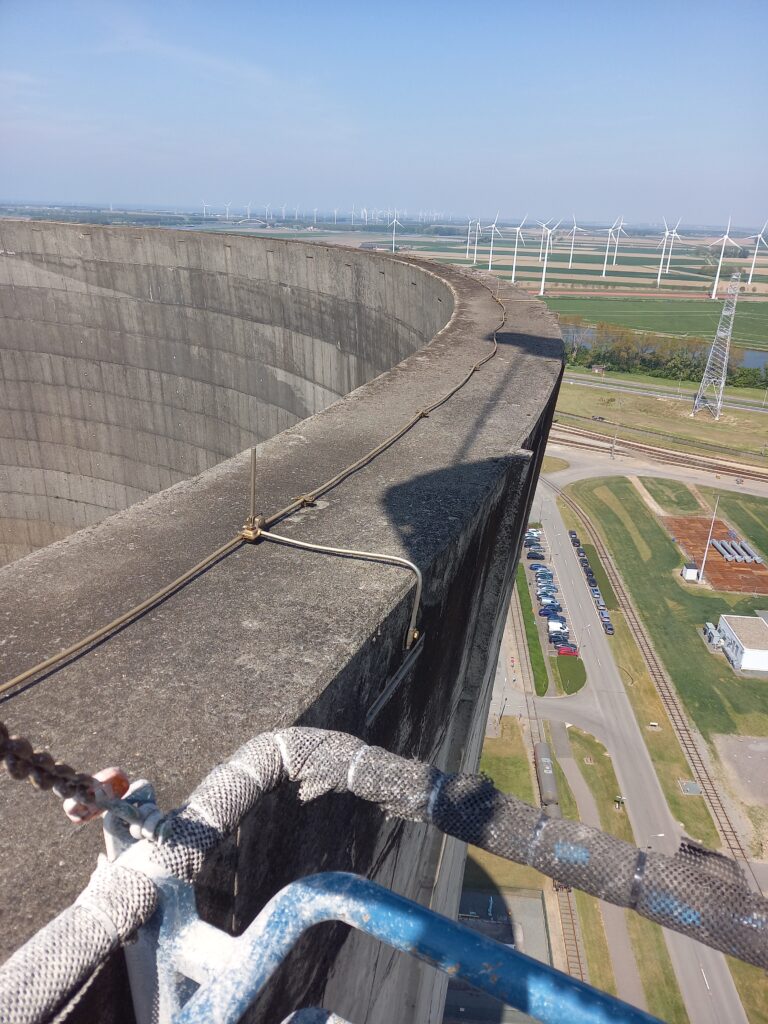
On-site investigation at height: Using an aerial work platform and a 250-tonne crane with man basket, concrete cores were drilled at 48 locations. Tests included concrete cover, carbonation depth, chloride profiles, porosity, compressive strength and petrographic analysis.
Service life analysis in DIMCOST: The probability of reinforcement depassivation by carbonation and by chlorides was calculated per location and visualised as a heat map of the shell per sector and level, based on fib Bulletin 34.
Key Results & Impact
Governing mechanism identified: Carbonation poses no significant risk (probability below 1% at all locations). Chloride ingress from the brackish cooling water is the governing mechanism, with chloride contents above the EN 206 limit up to at least 25 mm deep at most locations.
Zoning by height: The highest risk is found at the bottom of the shell and at the throat (smallest diameter). Repair and protection can be concentrated in these zones instead of the entire tower.
Cosmetic versus structural: Many visible defects turned out to be surface-related (air voids, formwork leakage) without general reinforcement corrosion. A local alkali-silica reaction was confirmed and flagged for follow-up.
By separating cosmetic surface defects from the real durability risk, DIMCOST gave the owner a heat map of where the shell needs protection first, and a solid basis for maintenance scenarios and budgets.


More use cases
Cooling towerCooling tower DrogenbosView case →
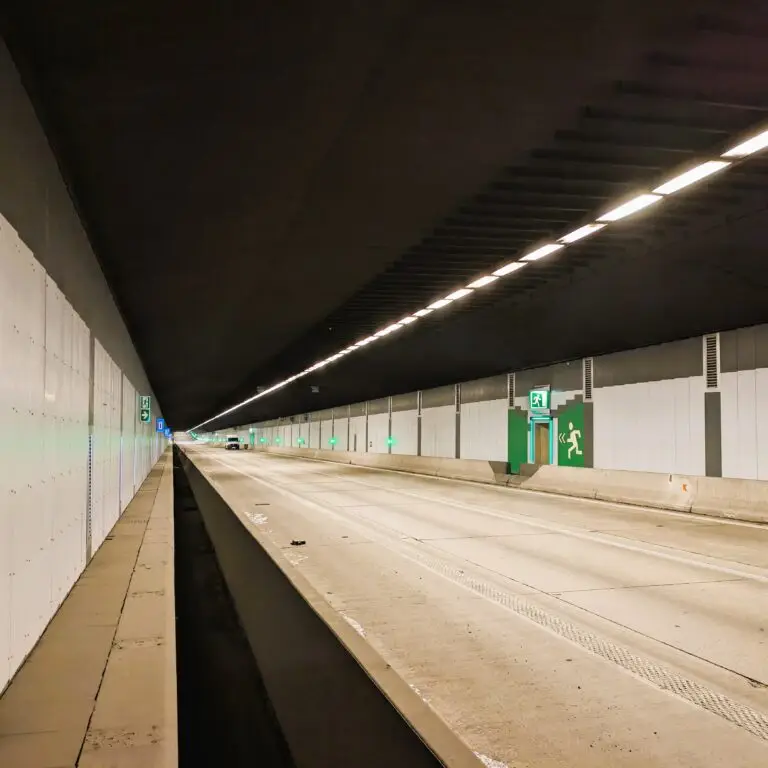
Road tunnelBeverentunnelView case →
Cooling towerCooling tower ZandvlietView case →
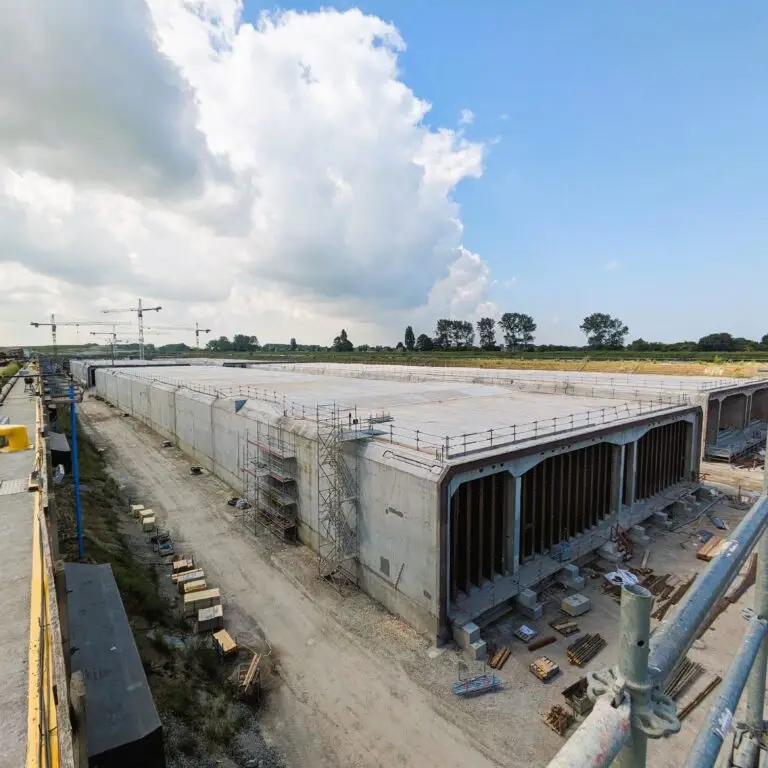
Tunnel segmentsTunnel segments Scheldt tunnelView case →
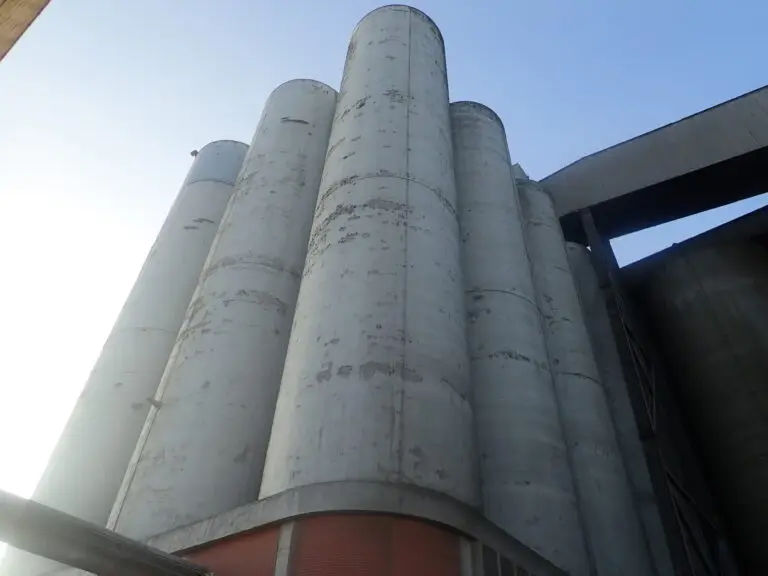
Industrial siloEurosilo GentView case →
One group, from inspection to decision
DIMCOST is developed within the SANACON group. Together with our sister companies, we cover the full chain from data capture on site to a well-founded maintenance strategy.
Plan a demoEngineering and structural advice: concrete durability, service life analysis, repair design and cathodic protection. Ghent University spin-off.
Visit sanacon.be →On-site concrete testing and core drilling: the field data on cover, carbonation and chlorides that feed the DIMCOST models.
Visit betonplus.be →Industrial drone inspections and 3D models, loaded directly into DIMCOST to map defects and track changes over time.
Visit medexon.com →See what DIMCOST can tell you about your own asset
Share your inspection data or describe your structure. We show you how a service life analysis turns it into a maintenance plan you can budget.